
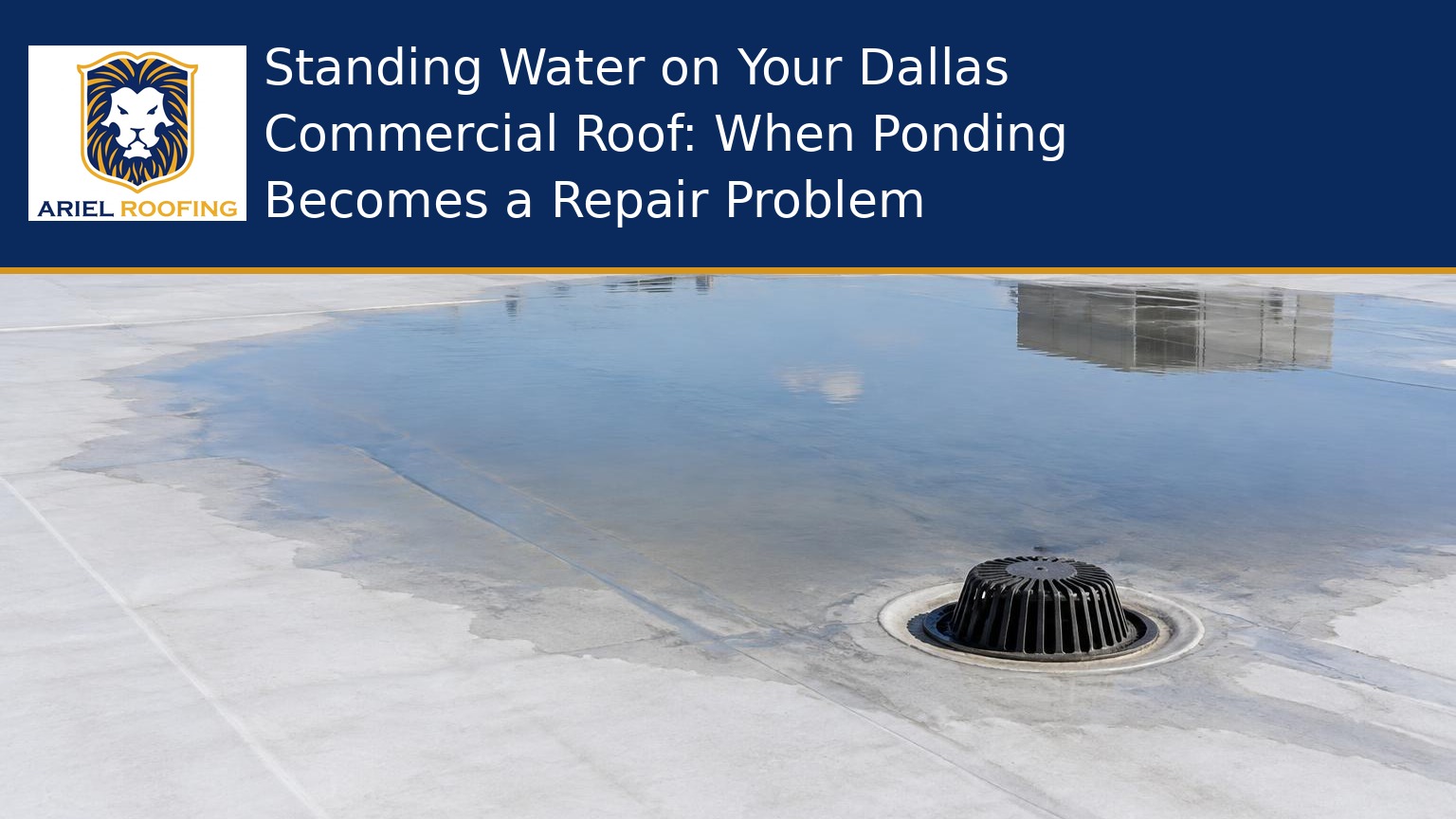
The rain has stopped, the parking lot is drying, and a broad patch of water is still sitting behind the rooftop air-conditioning unit. There may be no leak inside. For a Dallas commercial property owner, the useful question is not just whether that puddle looks bad. It is whether the roof can drain, what is holding the water there, and which details stay submerged each time it rains.
Standing water can be a maintenance issue, a localized roofing repair, or evidence of a larger drainage or structural problem. Those possibilities call for different work. Before approving a patch—or a full replacement—ask for a diagnosis that explains the water's path from the roof surface to its outlet.
What Is Ponding Water on a Commercial Roof?
Ponding is water that remains on the roof rather than draining away. GAF's technical bulletin for TPO and PVC defines it as water that does not drain or dissipate within 48 hours after precipitation ends. NRCA's published drainage guidance uses the same interval under conditions conducive to drying. See the GAF ponding-water bulletin and NRCA's slope and drainage guidance.
That benchmark is not a universal warranty exclusion or a safety deadline. Repeated rain, shade, temperature, and equipment discharge complicate the observation. More importantly, water entering the building or pooling over a visibly distressed area needs attention immediately, not after the clock reaches 48 hours.
A low-slope roof is not intended to work like a bathtub. Water needs a continuous route to drains or scuppers—the outlets through a parapet wall. A shallow pool that disappears after a shower differs from a persistent depression, but both are worth documenting if the pattern changes.
Why Dallas Owners Should Watch the Pattern After Rain
North Texas storms can combine heavy rainfall with wind and debris. The National Weather Service's account of the May 1995 DFW storm documents those hazards locally; it is historical context, not a prediction for your building. A drainage issue may become noticeable during a hard rain even if lighter showers caused no interior leak.
On a warehouse, roof sections may drain toward different internal outlets. At a retail center, equipment curbs and several tenant HVAC units can interrupt the water's route. Tree debris may matter at one property and rooftop service debris at another. The actual layout is more useful than assuming every Dallas flat roof has the same problem.
Dallas heat may dry a pool between storms without fixing the low spot. Look for the repeated outline of a puddle, sediment, or algae when an inspector visits on a dry day. Those marks suggest where to investigate; they do not establish water depth, concealed moisture, or structural capacity on their own.
Five Reasons Water Collects on an Otherwise Serviceable Roof
Start with the simplest explanation, but do not stop there if the water returns. An open drain does not prove the surrounding roof slopes toward it, and a clear strainer does not establish that downstream piping is unobstructed.
- Obstructed outlets: leaves, packaging, loose roofing debris, or sediment can restrict a drain or scupper. Downstream blockages may require a qualified plumbing specialist.
- Localized low spots: uneven insulation, compression, or changes in the deck can leave water below the outlet elevation. A roofer should distinguish surface geometry from suspected structural movement.
- Equipment obstructions: an HVAC curb, support, or poorly positioned detail can block the drainage path. Properly designed crickets—small sloped roof sections—can redirect water around an obstruction.
- Alterations and accumulated repairs: added equipment, raised patches, or changed roof levels can redirect runoff. Compare the affected area with prior work records.
- Equipment discharge: condensate may keep an area wet even without rain. The mechanical contractor should assess the discharge arrangement; roofing repairs alone may not remove the water source.
When Ponding Becomes a Repair Problem
The strongest reason to investigate is a recurring pool combined with a vulnerable detail. Water around an open seam, split flashing, deteriorated patch, or damaged drain connection creates more opportunity for entry than the same pool over intact waterproofing. The absence of a ceiling stain does not establish that the concealed assembly is dry.
Consider a hypothetical retail roof where water sits against an HVAC curb after each storm. Replacing the curb flashing may address an opening, but it leaves the drainage obstruction unchanged. Conversely, redirecting runoff does not repair an already-open flashing. The proposal should explain whether one problem or both are present.
On a hypothetical warehouse roof, debris removal may restore drainage completely. If a pool remains after the outlet is cleared, repeatedly charging for drain cleaning is not a diagnosis. The next step is to assess elevations, the drain connection, and the surrounding assembly. These examples illustrate decisions; they are not claims about completed Ariel Roofing projects.
| Observed condition | What it may indicate | Next step |
|---|---|---|
| Small pool dries; no other symptoms | Temporary retention or a localized low spot | Document the pattern and review it during planned maintenance. |
| Same pool persists after drying conditions return | Obstruction, slope deficiency, or ongoing equipment discharge | Arrange a drainage-focused inspection; identify the cause before selecting work. |
| Water surrounds damaged seams or recurring patches | A roofing defect exposed to repeated wetting | Assess compatible detail repairs and drainage correction together. |
| Active interior leak or wet inventory | Water entry requiring prompt response | Protect people and contents; request urgent professional assessment. |
| Rapidly expanding pool, visible sagging, or unusual movement | Possible structural distress | Restrict access and seek emergency help and structural evaluation. |
What an Owner Can Safely Record Before the Visit
Record when rain stopped, whether more rain followed, and where occupants noticed water indoors. Collect existing roof photographs only when they can be obtained through safe, authorized access. Do not send staff onto a wet roof simply to measure a puddle. Water can conceal damaged surfaces, and edges, skylights, electricity, and unstable decking add hazards.
Give the contractor a building plan or a simple location reference: above the west stockroom, behind rooftop unit three, or near the rear parapet. Include recent mechanical work and earlier repair invoices. Interior stains are useful evidence, but water can travel within the assembly before appearing below.
Do not drill drainage holes, remove strainers, cut a new scupper, or improvise pumping. Those actions can damage waterproofing, alter drainage behavior, or introduce hazards. If a roof appears overloaded or is visibly sagging, seek specialist direction rather than attempting to remove the water yourself.
What a Drainage-Focused Roof Inspection Should Include
Ask the inspector to identify the installed system, accessible outlets, surrounding seams and flashings, debris patterns, and recurring low areas. Primary drainage and any secondary overflow provisions should be reviewed together. Where water collects, the report should distinguish an observed defect from a suspected cause requiring further evaluation.
The assessment should also consider the route beyond the roof outlet. A roofer can review the waterproofing at a drain, while piping faults or drainage design may require other qualified specialists. Suspected deck deflection belongs with a structural professional. Ariel Roofing's role is roofing assessment and work, not a substitute for engineering or plumbing design.
Visual inspection cannot establish the condition of every concealed layer. A moisture survey or selective core sampling may be appropriate where findings justify it, but testing requires a defined scope and authorization. Ask what each method can establish and how uncertain results will be checked.
Use Ariel Roofing's commercial roof inspection services to discuss a Dallas property assessment. Request dated photographs with identifiable locations, access limitations, prioritized findings, and a clear distinction between maintenance, roofing repair, and specialist referrals.
Repair Options: Match the Work to the Cause
Cleaning may be enough when debris is the only problem and drainage returns to normal. A damaged seam, drain flashing, or curb detail may need a compatible localized repair. TPO and PVC seams generally use heat-welded details; EPDM and asphalt-based assemblies require their own approved repair methods. Material compatibility matters more than calling every product a flat-roof sealant.
A recurring low spot may call for tapered insulation, crickets, or an appropriately designed change to the drainage arrangement. These are not interchangeable add-ons. The scope should address water flow, transitions, attachment, applicable approvals, and how the work meets the installed system's requirements. If the problem involves concealed wet materials or structural movement, deal with those findings rather than covering them.
A coating can address certain eligible roof conditions, but it does not change the elevation of a low spot or restore a blocked pipe. Products differ in their tolerance for sustained ponding. GAF's guidance for coatings on roofs with poor drainage illustrates why the specific product, substrate, and installation requirements matter. It is not a blanket recommendation to coat any wet roof.
For confirmed roofing defects, discuss roof repair services with Ariel Roofing. Ask for a written scope that separates the immediate water-entry repair from any drainage correction and states how the result will be checked after rainfall.
Does Standing Water Mean You Need a New Roof?
Not by itself. A generally serviceable roof with a localized obstruction or repairable detail is a different case from widespread moisture, deteriorated materials, or extensive drainage deficiencies. Replacement should follow documented assembly condition and repair feasibility, not a photograph of one puddle.
For broader warning signs, read the earlier guide to commercial roof replacement in Dallas. If you are unsure what is installed, the previous Dallas commercial roof identification guide explains visible system differences. Those guides help frame questions; neither replaces an assessment of your own roof.
Review the actual warranty before authorizing work. Ponding does not automatically void every roof warranty, and coverage differs by product, guarantee, and circumstances. Ask the manufacturer or issuer about the proposed repair method and any notice or approval requirements. Avoid treating one manufacturer's bulletin as the terms for every installed roof.
How to Compare Commercial Roof Repair Proposals
A responsible price follows the findings. Access, roof system, affected area, concealed moisture, repair compatibility, drainage changes, and coordination above occupied space all influence the scope. A warehouse loading area may need different staging from a retail unit with customers beneath the work.
Compare what each proposal actually includes: outlet cleaning, detail repair, moisture investigation, removal of damaged layers, slope correction, disposal, and any specialist work. Ask which costs are firm, which depend on further findings, and how additional work will be authorized. A cheap patch and a drainage correction are not equivalent bids.
After work, retain location photographs and monitor the same area following rain when safe access is available. A repair should be evaluated against the original finding: is the entry point corrected, has drainage improved, and what conditions remain? One dry day is not proof that a recurring drainage problem has been solved.
Give the Next Rain Event a Better Outcome
If water keeps returning to the same part of your Dallas commercial roof, start with the property details and a clear assessment request. Share the leak history, recurring pool location, available warranty documents, and recent rooftop work with Ariel Roofing through the inspection page above.
Ask for an explanation of why the water stays, which roofing details need attention, and what requires another specialist. That gives your team a usable decision: maintenance where it is enough, repair where it is justified, and broader planning where the evidence supports it.