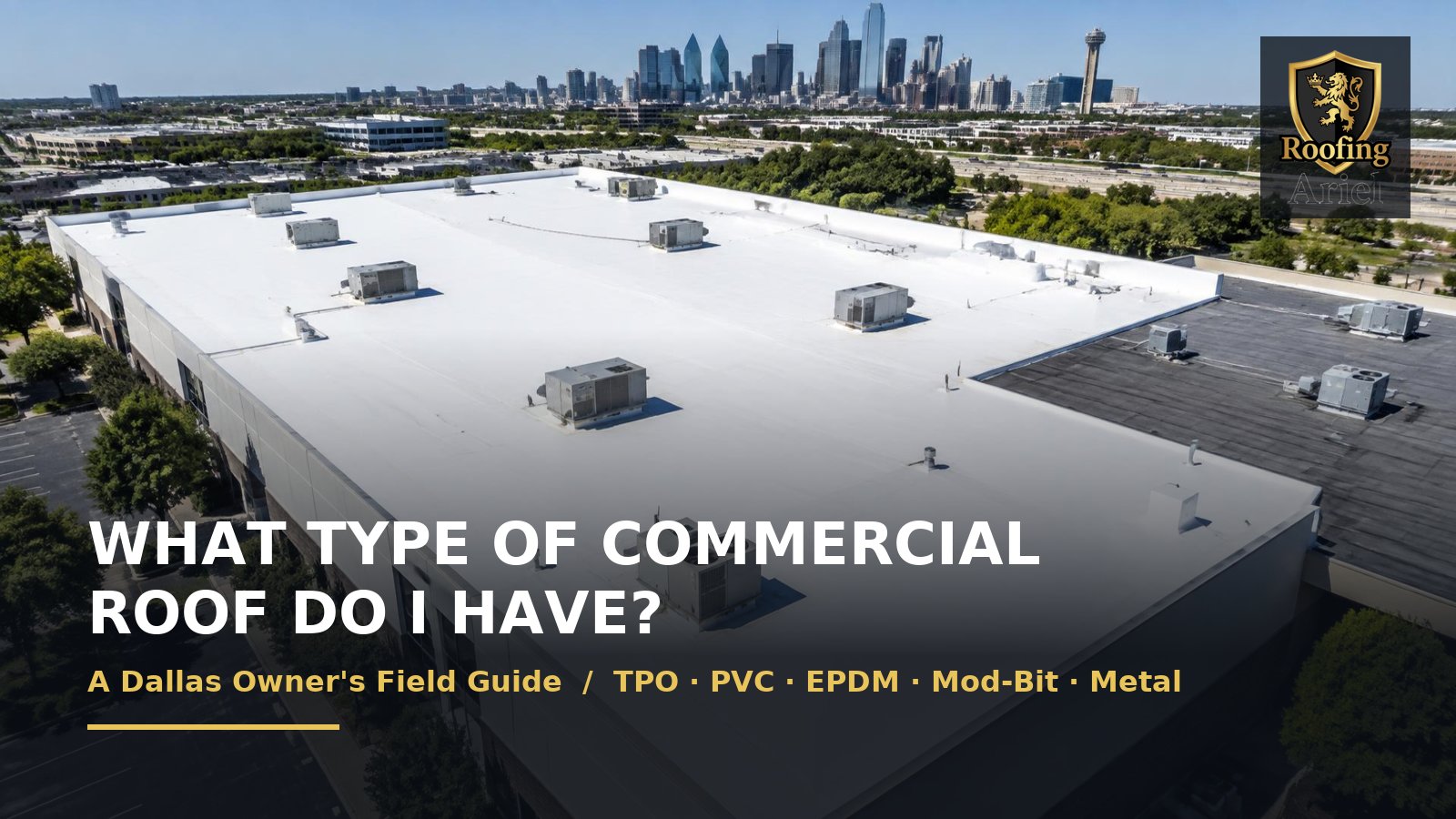
"What type of commercial roof do I have?" is one of the first questions Dallas building owners ask — usually right after a leak or a hailstorm. Walk onto almost any commercial roof in Dallas and you'll notice something right away: very few people in the building actually know what the roof is made of. Owners inherit roofs with a property. Property managers change. The contractor who installed it may have closed years ago, and the paperwork is in a box nobody has opened since.
That gap becomes expensive the moment something goes wrong. A leaking roof gets bid by three contractors who each assume a different system. An insurance adjuster asks for membrane thickness and the owner has no answer. A well-meaning maintenance tech spreads asphalt patch over a rubber membrane and creates a bigger problem.
The good news: identifying a commercial roof is genuinely easy. Most systems announce themselves through color, seams, fasteners, and surface texture. This guide walks through each of the six systems common on Dallas buildings, how to tell them apart, and why the answer changes how you repair, insure, and budget for the roof.
Why knowing what type of commercial roof you have matters
It's tempting to treat "what kind of roof do I have?" as trivia. It isn't. The system on your building drives four things that all cost money:
- Repair compatibility. Single-ply membranes are heat-welded, taped, or adhered with system-specific materials. A repair made with the wrong material may hold for a few weeks, then fail — and the contractor who did it won't be back for free.
- Warranty validity. Most manufacturer warranties require repairs by an approved applicator using matching materials. An off-brand patch on a TPO seam can void coverage on the whole roof, not just the patched area.
- Insurance claims. After North Texas hail, adjusters document the roof system, its thickness, and attachment before writing an estimate. Owners who can name their system and produce records settle claims faster.
- Budget planning. Each system ages differently. A 15-year-old TPO roof and a 15-year-old EPDM roof are at very different points in their lives, and knowing which you have changes whether you budget for a patch, a coating, or a replacement.
TPO: the white membrane you'll see most in Dallas

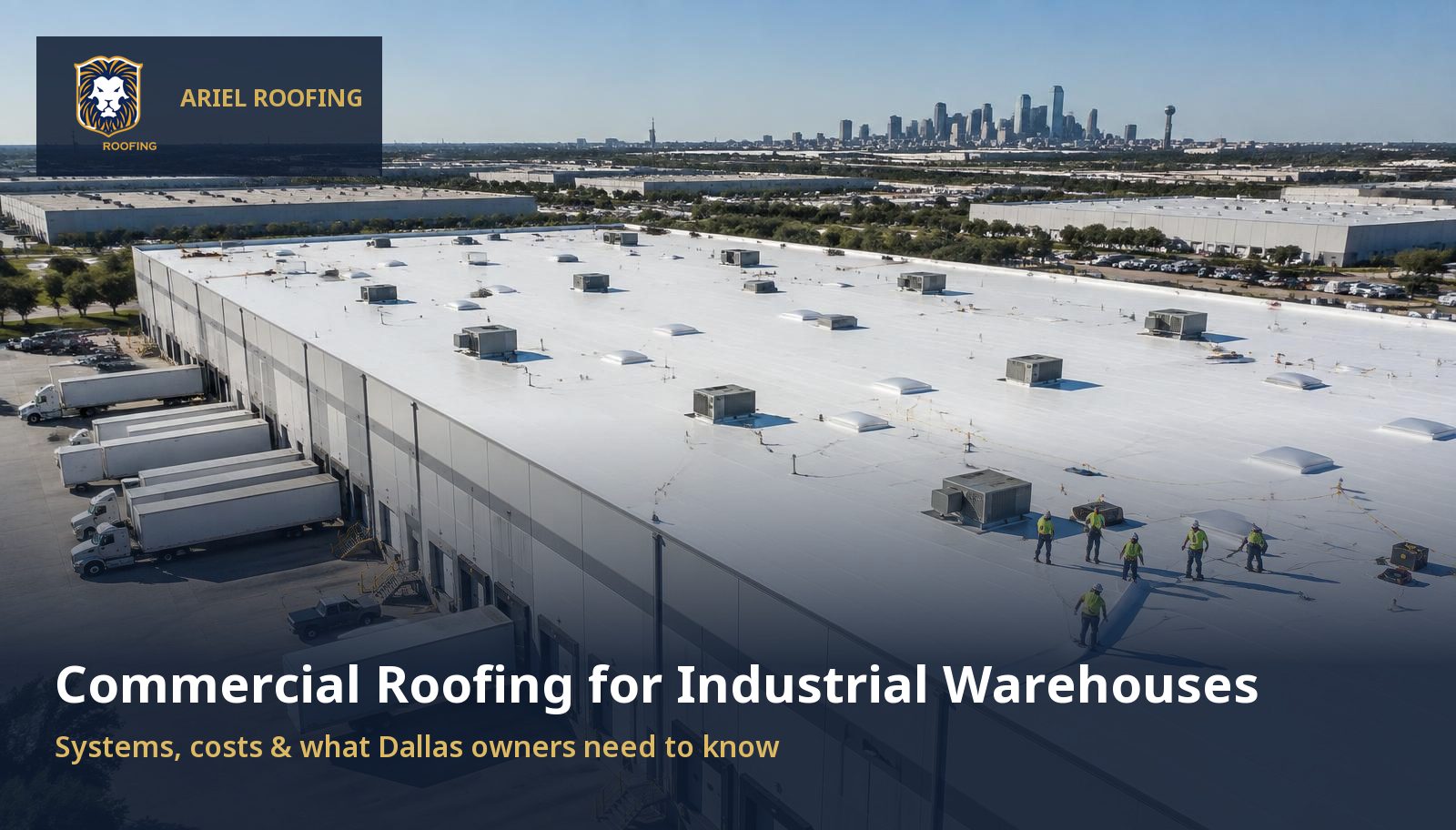
TPO (thermoplastic polyolefin) is the most common commercial roof on buildings constructed or re-roofed in Dallas over the last two decades. It's a single-ply membrane, usually white, installed in wide rolls with seams welded together by hot air.
How to recognize it: the surface is bright white (occasionally gray or tan) and smooth, with flat welded seams that look like they've been ironed together. There are no loose granules underfoot and no gravel. Around the perimeter and at penetrations, you'll often see termination bars and metal edge details.
If you look at the edge of a seam or a cut patch, TPO is a single layer of material — typically 45, 60, or 80 mils thick. Thickness matters for hail performance and warranty terms, so if you find a scrap piece or an old warranty document, the mil thickness listed is worth knowing.
PVC: the chemical-resistant cousin
PVC looks a lot like TPO — white, welded seams, single-ply — which is why even some contractors mix them up. Two details help tell them apart. PVC seams often have a visible weld bead squeezed out along the seam edge, and many PVC membranes show a slight surface pattern or grid from the reinforcement scrim embedded in the sheet. PVC also stays more flexible in cold weather.
The distinction matters most for buildings with kitchens, food processing, manufacturing exhaust, or anything that vents grease or chemicals onto the roof. PVC resists those contaminants; TPO degrades faster where they collect. If your building handles food or chemicals, confirm which membrane you have before authorizing any repair.
EPDM: the black rubber roof

EPDM is a synthetic rubber membrane, almost always black, and it's been installed on Dallas buildings since long before TPO took over. If your roof looks like a giant inner tube — soft underfoot, black in the sun, with seams that are taped or covered with narrow strips rather than welded flat — you have EPDM.
Seams are the tell. TPO and PVC seams are welded into one continuous sheet. EPDM seams are made by taping or splicing two sheets with primer and adhesive, and on older roofs you may see exposed seam tape edges lifting at the corners.
EPDM ages well against heat and cold, which is why it's common on older office buildings, churches, and schools across Dallas. Its weakness here is the opposite of TPO: a black surface absorbs heat, so it works harder against Texas summers unless it has been coated white.
Modified bitumen: layered asphalt with a grainy surface
Modified bitumen is an asphalt-based system installed in rolls, usually two plies. The top surface is either smooth or covered with mineral granules — if it looks and feels like a giant asphalt shingle roof, that's exactly what it resembles. Seams are torched, mopped, or self-adhered, and on older roofs you may see surface cracking or alligatoring as the asphalt ages.
It's common on older industrial buildings, small retail strips, and on sections of roof that get heavy foot traffic around equipment, because it's tough to walk on. Repairs are asphalt-based — mastic, mesh, and cap sheets — which is why the wrong single-ply patch on a mod-bit roof never quite adheres.
A related system, built-up roofing (BUR), shows up as a gravel surface: layers of asphalt and felt topped with loose stone. If you can't see any membrane color at all because of gravel, you're likely on a BUR roof, and the membrane underneath can only be assessed by lifting a test area.
Metal: panels, seams, and fasteners

Commercial metal roofs come in two families. Structural standing seam has tall raised seams running down the panel, with no exposed screws — the fasteners clip under the seams. Through-fastened (or exposed-fastener) metal shows a screw with a rubber washer every couple of feet down each panel.
Both are easy to identify: it's obviously metal, and panels run in regular lines. What you want to note is which family you have, because they age differently. Through-fastened roofs live and die by their washer seals, which dry out in Texas heat and need periodic screw replacement. Standing seam moves with expansion and rarely leaks, but hail can dent panels and seams can back out on long runs.
A 10-minute identification checklist
You don't need to climb up often, and safety comes first — never walk a wet roof or one without proper access. But when you or a maintenance tech are up there, these four checks identify almost every roof in Dallas:
- Color and texture: bright white and smooth (TPO or PVC), black and rubbery (EPDM), grainy like a shingle (modified bitumen), gravel-covered (BUR), metallic lines (metal).
- Seams: welded flat into the sheet (TPO/PVC), taped strips (EPDM), rolled laps (mod-bit), raised ribs (standing seam metal).
- Fasteners: exposed screws with washers mean through-fastened metal or an older mechanically fastened single-ply roof.
- Edges and penetrations: flashing type, termination bars, and pitch pockets often reveal the system and its age before anything else does.
Check the paperwork before you trust your eyes
Visual identification gets you most of the way. The exact product, thickness, and warranty status — comes from documents. Three places to look:
- City of Dallas permit records: re-roofing permits list the system installed and when.
- Warranty documents: the manufacturer warranty names the product, thickness, coverage term, and the contractor who installed it.
- Old invoices or the property's due-diligence file from when you bought the building.
Repair, restore, or replace? What your roof type tells you
Once you know the system, the next question is usually whether it can be fixed. The roof type narrows the options, but condition makes the final call. Here is how the decision usually breaks down on Dallas commercial roofs:
- Repair usually makes sense when damage is limited to a few seams, flashings, or punctures, the insulation below is dry, and the membrane still has usable life. Repairs must match the system: heat-welded patches for TPO and PVC, EPDM-specific tapes and primers, asphalt-based materials for mod-bit.
- Restoration or coating can extend a roof that is weathered but still watertight. Silicone and acrylic coatings are common over aging TPO, EPDM, mod-bit, and metal once a moisture survey confirms the substrate is dry.
- Replacement is typically the better call when much of the insulation is wet, leaks keep returning after repairs, hail has fractured the membrane across the field, or the roof already has two layers and code won't allow another.
What identification can't tell you
Knowing your roof type is not the same as knowing your roof's condition. Two roofs of the same material, on the same street, can be in completely different shape depending on installation quality, drainage, foot traffic, and storm history.
The things that actually decide whether a roof needs a repair, a coating, or a replacement are underneath: whether the insulation is wet, whether the deck is sound, how much of the field has usable life left. That takes core samples or infrared scanning during a real inspection. In North Texas it also takes a close look after every significant hailstorm, because impact damage doesn't always show from the ground — or from a quick walk.
For a deeper comparison of how the single-ply options behave on Dallas rooftops, our TPO vs. PVC vs. EPDM guide covers each system in detail.
Know your roof, then get it documented
Once you know what's on your building, write it down where the next owner or manager will find it: system, approximate install date, thickness if known, warranty status, and the contractor of record. Photograph the rooftop annually. That five-minute habit is what makes insurance claims, warranty service, and contractor bids fast and fair.
If you're not sure what covers your building — or you know the type but not the condition — an inspection settles it. Ariel Roofing inspects commercial roofs across Dallas and the surrounding metro, documents the system and its condition in writing, and gives you repair, restoration, and replacement options with real scopes. Book a free inspection or call +1 469-833-2332.