If you own or manage a commercial building in Dallas, your roof is probably the most expensive component you think about the least. It sits out of sight, doing its job, right up until it doesn't — and by then the water is already inside, over inventory, equipment, or a tenant's space.
Commercial roofing in Dallas carries stakes that go beyond keeping rain out. The roof affects cooling costs through a long Texas summer, determines how the building weathers hail season, and shows up in insurance conversations, lease negotiations, and property valuations. Owners who understand the basics — what system they have, what shape it's in, and what it needs — make better decisions and spend less over the life of the building.
This guide covers what Dallas business owners actually need to know: how local conditions shape roofing requirements, how the major systems differ, what drives cost, the problems we see most, and how to think about maintenance, repair, and replacement. If you'd rather have someone walk your roof and explain it in person, our team provides commercial roofing services in Dallas with documented inspections and straight answers.
Understanding Commercial Roofing Requirements in Dallas
A warehouse in Garland, a retail strip in Richardson, and an office building in downtown Dallas may all have flat roofs, but they don't have the same roof. Requirements shift with how the building is used, what's mounted on top of it, and who is inside it.
Warehouses and distribution centers usually mean large, open roof areas with long spans between drains. The concerns there are drainage design, membrane durability across big expanses, and keeping operations running during any work. Retail and restaurant buildings add a different complication: kitchen exhaust. Grease vented onto a roof destroys some membranes quickly, which is why material choice matters so much for those properties.
Office complexes and medical buildings bring foot traffic — technicians servicing rooftop HVAC units every month — plus a lower tolerance for noise, dust, and disruption during projects. Industrial facilities around Irving and Arlington may vent chemicals or run processes that heat the roof from below. Each of these changes what 'the right roof' means, which is why a contractor's first job is to understand the building, not to sell a product.
Choosing the Right Commercial Roofing System
Five systems cover most of the commercial roofs we work on across Dallas-Fort Worth. Each has a genuine strength and a situation where it's the wrong choice. For a deeper side-by-side look, see our guide to commercial roofing materials and their differences.
TPO roofing

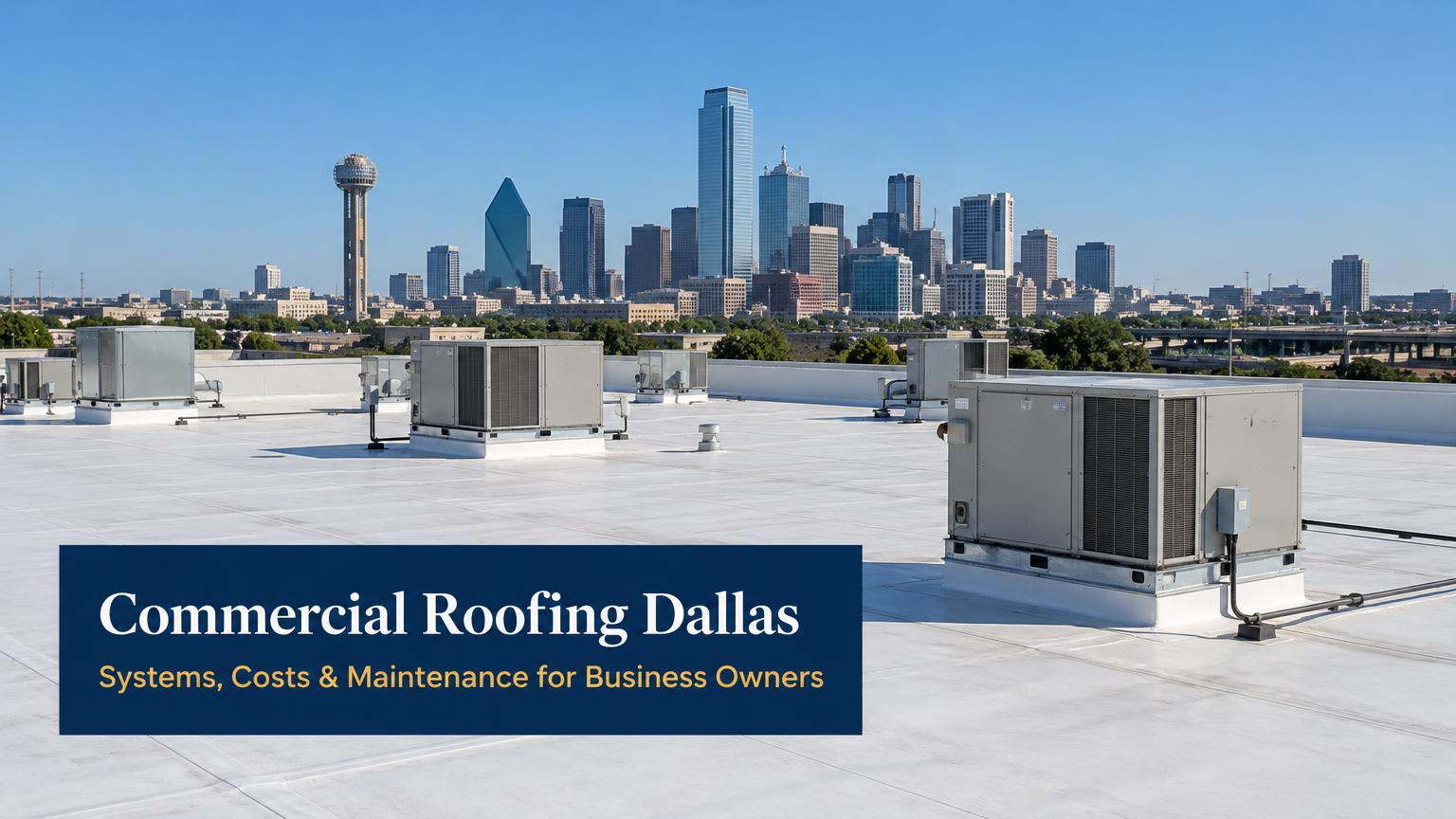
TPO is the white single-ply membrane you see on most newer low-slope roofs around Dallas, Plano, and Carrollton. It reflects sunlight rather than absorbing it, which takes real load off cooling systems from June through September. Seams are heat-welded into a continuous sheet, and it installs efficiently over large areas, which is why it dominates warehouse and retail work.
The caveats: thickness and formulation vary, and weld quality depends entirely on the crew. A cheap, thin TPO installed carelessly is worse than a mid-grade alternative installed well.
PVC roofing
PVC looks similar to TPO — white, reflective, heat-welded — but its chemistry resists grease, oils, and many chemicals. For restaurants, food processing, and buildings with heavy rooftop exhaust, PVC is often the correct answer even though it typically costs more. For a plain office or warehouse, that premium usually buys nothing.
EPDM roofing
EPDM is synthetic rubber with a decades-long track record. It stays flexible through the temperature swings North Texas throws at it — a 40-degree morning after an 80-degree afternoon — and handles hail respectably in thicker grades. Standard EPDM is black and absorbs heat, so in Dallas it's worth discussing white EPDM or a reflective coating. Its seams are taped or adhered rather than welded, which makes seam workmanship the critical variable.
Modified bitumen roofing
Modified bitumen is an asphalt-based, multi-ply system — think of it as the modern descendant of the old built-up roof. It's tough under foot traffic, handles punctures better than single-ply membranes, and suits smaller roofs, roofs with heavy equipment access, and buildings where durability matters more than reflectivity. It also performs well on the older commercial buildings common in established parts of Dallas and Fort Worth.
Metal roofing
Standing-seam metal fits sloped commercial roofs and owners with long holding horizons. It sheds water fast, handles wind well when properly engineered, and can outlast membrane systems by a wide margin. Hail will dent it — cosmetic damage that rarely affects performance but matters to some owners and insurers. Upfront cost is higher, so the math works best when you plan to own the building for decades.
How Much Does Commercial Roofing Cost in Dallas?
This is the question every owner asks first, and the honest answer is that no responsible contractor prices a commercial roof from a phone call or a website calculator. Two buildings of identical square footage can differ by a factor of two or more once you account for what's actually on and under the roof. What we can give you are the factors that move the number:
- Roof size and accessibility — large open roofs cost less per square foot than small, cut-up ones; tight urban sites with no staging room cost more than a warehouse with a parking lot.
- Existing roof condition — a roof that can be overlaid or restored is a different project than one needing full tear-off, deck repair, or wet insulation removal.
- Material selection — membrane type and thickness, metal gauge and profile, and manufacturer warranty tier all carry different price points.
- Insulation requirements — current energy codes often require more insulation than older buildings have, and tapered insulation to fix drainage adds material and labor.
- Drainage and structure — adding drains or scuppers, correcting ponding, or addressing deck deterioration changes the scope significantly.
- Repair versus replacement — targeted repairs or a restoration coating can defer a full replacement for years when the underlying roof still qualifies.
- Labor and complexity — rooftop equipment to work around, occupied tenants below, phasing requirements, and safety logistics all affect the crew size and schedule.
- The only path to a real number is a documented on-site inspection followed by a written, line-item proposal. Be cautious of anyone who quotes a firm price before they've been on the roof — that number is either padded or wrong.
Common Commercial Roofing Problems in Dallas
After years of working on commercial roofs across DFW, the same handful of problems account for most of the service calls. Knowing them helps you spot trouble early, when it's still cheap.
Hail damage

North Texas sits in one of the country's most active hail corridors. On membranes, hail bruises the surface and can fracture the substrate beneath it; on metal, it dents; on older built-up roofs, it cracks. The damage is frequently invisible from the ground and from a casual walk on the roof — which is why post-storm inspections matter even when nothing is leaking yet.
Wind and storm damage
Spring storms bring straight-line winds that attack perimeter edges and corners first. Once an edge lifts, wind gets under the membrane and the failure grows. Loose edge metal, lifted flashing, and displaced rooftop equipment are the usual findings after a major storm rolls through Dallas, Frisco, or McKinney.
Leaks and water intrusion
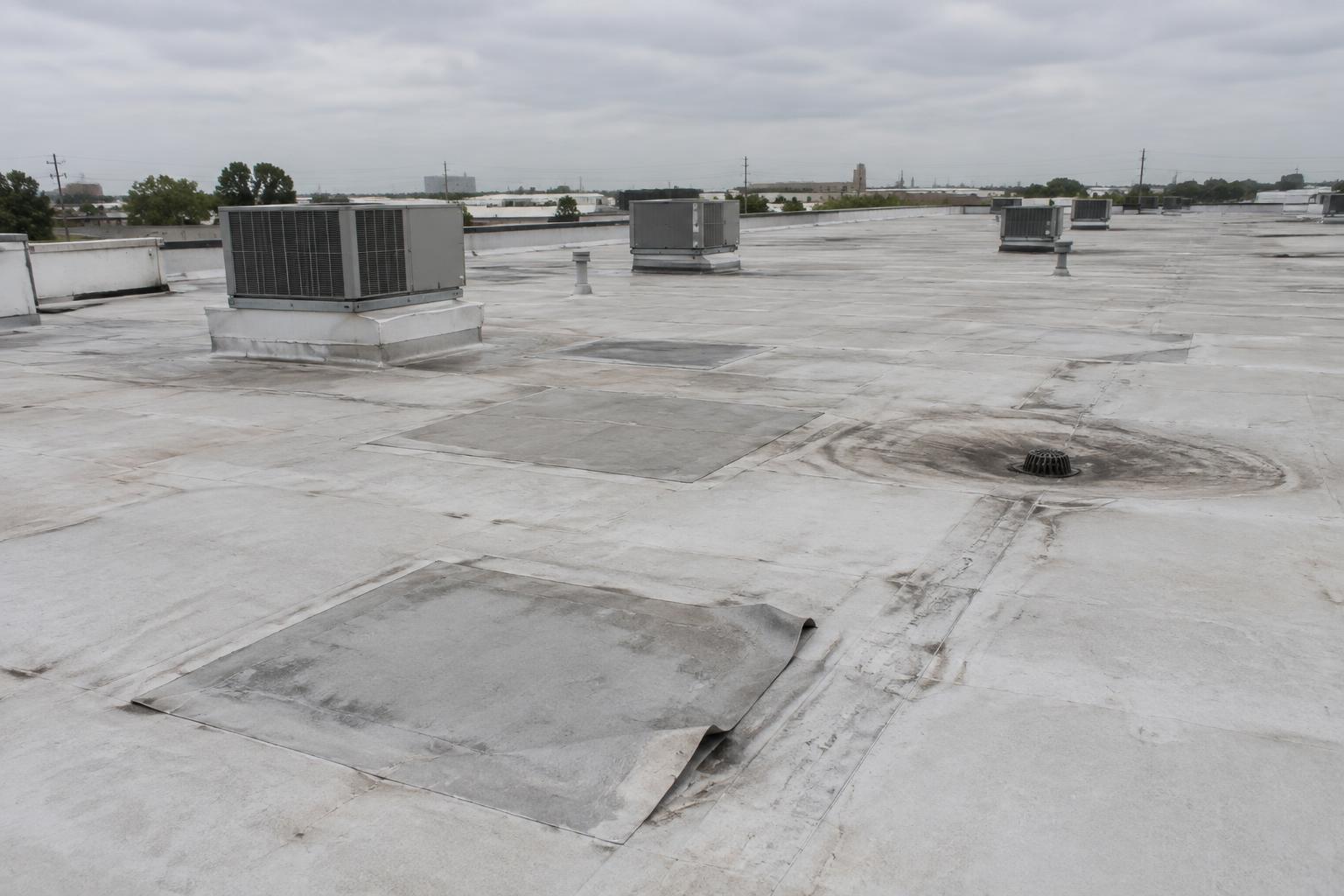
Most commercial leaks don't come from the middle of the roof — they come from penetrations: HVAC curbs, pipes, skylights, and where the roof meets a wall. Water also travels, so the stain on the ceiling tile may be thirty feet from the actual entry point. Tracing leaks is diagnostic work, not guesswork.
Ponding water
Water that stands on a flat roof more than a couple of days after rain is working on your roof full-time. It accelerates membrane breakdown, adds weight, finds seam weaknesses, and turns small defects into leaks. Ponding is a drainage problem, and the fix is usually tapered insulation or added drains — not just patching the membrane.
Flashing and seam failures
Flashings and seams are where roofing systems end and begin, so they're where failures concentrate. Age, movement, and UV exposure dry out sealants and stress joints. The good news: caught early, flashing and seam repairs are among the least expensive work on a commercial roof.
UV exposure and deterioration
Dallas sun is relentless. UV breaks down asphalt-based products, dries sealants, and ages membranes from the day they're installed. Reflective surfaces slow this; dark surfaces accelerate it. UV damage doesn't announce itself — it shows up as brittleness and cracking that an inspection catches before leaks start.
Commercial Roof Maintenance and Inspection in Dallas

The math on maintenance is simple: nearly every expensive roof failure started as an inexpensive repair. A failed pipe boot costs little to fix; the saturated insulation, stained ceiling, and damaged inventory it eventually causes do not.
For most Dallas commercial buildings, we recommend inspections twice a year — once before spring storm season and once in the fall — plus a check after any major hail or wind event. A real inspection produces documentation: dated photos, notes on membrane, seams, flashings, drains, and penetrations, and a written condition summary you can file. That record matters for warranty claims, insurance conversations, and budgeting.
Between inspections, facility managers can help by keeping drains and scuppers clear, limiting rooftop foot traffic, and making sure HVAC contractors don't leave screws, panels, or tools on the membrane. If you don't have a program in place, our preventative maintenance work is built around exactly this kind of scheduled, documented care.
When Should You Repair, Restore or Replace a Commercial Roof?
This decision should follow from the roof's condition, not from what a salesperson wants to sell. Each option has a legitimate place:
- Repair makes sense when damage is localized — a few penetrations, a flashing failure, isolated storm damage — and the rest of the roof is sound and relatively young.
- Restore (typically a coating system) makes sense when the membrane is aging but still fundamentally intact, insulation is dry, and seams are repairable. A restoration can add years of service at a fraction of replacement cost, but only if the roof genuinely qualifies — coating over wet insulation just seals the problem in.
- Replace makes sense when leaks are recurring in multiple areas, insulation is wet across significant portions of the roof, the membrane is at the end of its service life, or repair costs are adding up to a meaningful fraction of replacement.
- The deciding evidence is moisture. A proper assessment — visual inspection plus moisture scanning or core samples where warranted — tells you how much of the roof is actually compromised. Age matters too: pouring repair money into a roof near the end of its life is usually worse economics than replacing on your own schedule instead of the roof's.
Selecting a Commercial Roofing Contractor in Dallas
The contractor matters as much as the material. The best membrane installed poorly will fail early; a mid-grade system installed carefully will serve for decades. When evaluating commercial roofing contractors in Dallas, look for:
- Documented inspections before pricing — a contractor who quotes without getting on your roof is guessing.
- Proper insurance — general liability and workers' compensation, verified with certificates, not promises.
- Safety practices — commercial roofing is high-risk work; ask how they protect their crews and your occupants.
- Material knowledge across systems — a contractor who installs only one product will recommend only one product.
- Written, line-item proposals — so you can compare scope, not just totals.
- Warranty clarity — manufacturer and workmanship warranties explained in writing, including what maintenance they require.
- Local presence — a company that works in DFW year-round will be here for the warranty call in year eight.
- After hail events, be especially careful. Storm-chasing crews flood North Texas, and some use high-pressure tactics or offers to 'cover your deductible' — which is illegal in Texas. A contractor who starts with an inspection and a written scope, and is comfortable letting you think it over, is usually the right kind.
A commercial roof is a long-term asset, and in Dallas it works harder than most. The owners who get the most life out of theirs share a few habits: they know what system they have, they inspect it on a schedule, they fix small problems while they're small, and they make repair-versus-replace decisions on documented condition rather than urgency or sales pressure.
If you'd like that kind of clarity on your own building — whether it's a warehouse in Arlington, a retail center in Plano, or an office in downtown Dallas — contact Ariel Roofing for a documented commercial roof inspection. We'll walk the roof, show you exactly what we find with photos, and give you a straight answer on what it needs, what it doesn't, and what your options cost.