
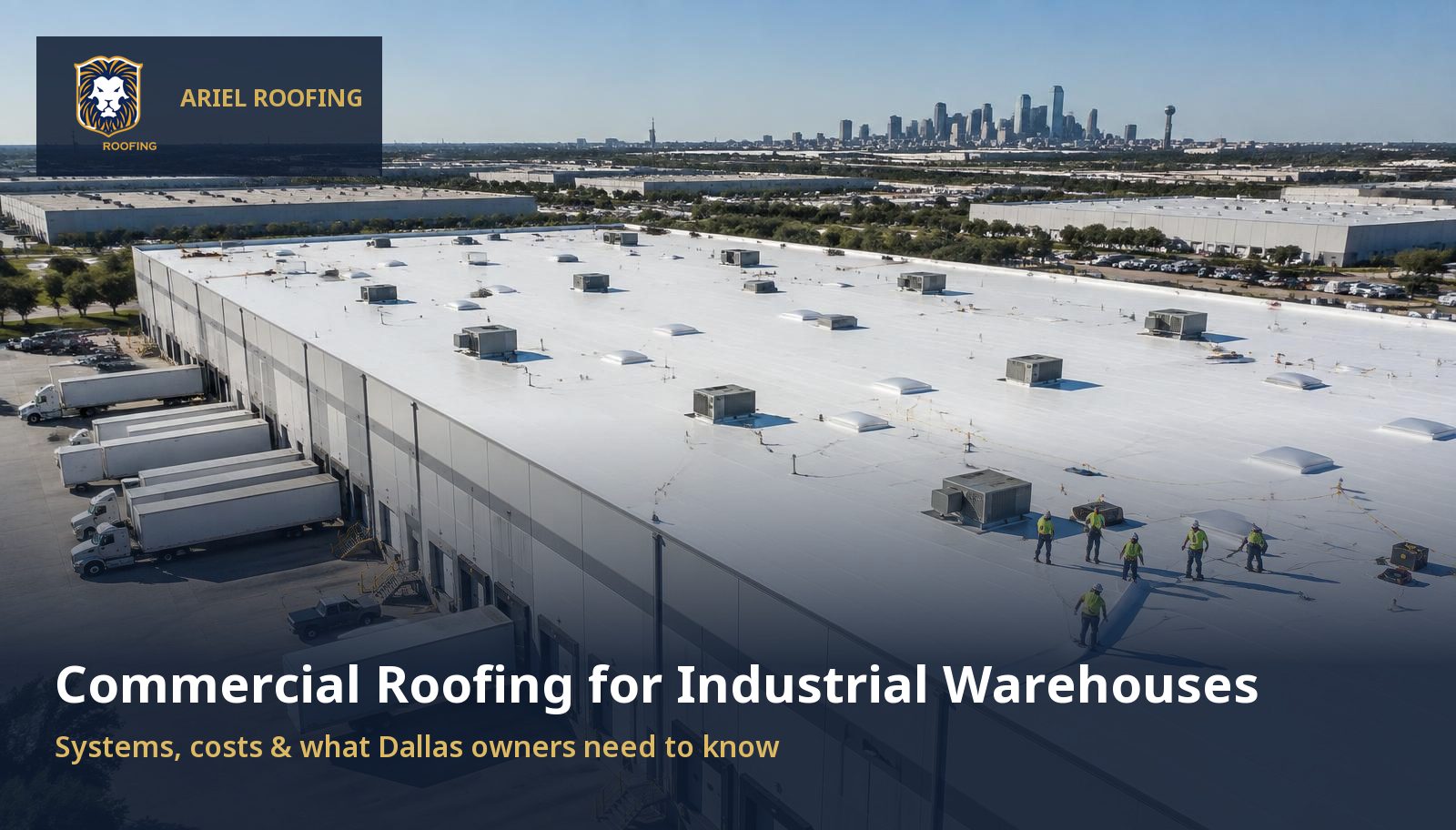
Commercial roofing for industrial warehouses is a different job from roofing a house or a small office. The roof is huge, usually low-slope, loaded with equipment, and sitting over inventory and people who can't simply stop working while a crew figures things out.
In Dallas, that roof also takes a beating. Summer surfaces bake well past 150°F, spring storms bring hail and straight-line winds, and a single wet week can reveal every weak seam. This guide explains the main industrial warehouse roofing systems, what actually drives cost, and how to tell when a roof needs repair, restoration, or full replacement.
If you're comparing membrane options in more depth, our TPO vs. PVC vs. EPDM comparison for Dallas buildings goes system by system.
Why warehouse roofs in Dallas need a different approach
Most warehouses and distribution centers around Dallas, Grand Prairie, Irving, and the I-20 and I-35E corridors are tilt-wall or pre-engineered steel buildings. Many have steel decks, tall clear heights, and roofs measured in acres rather than squares.
That scale changes the math. A small defect repeated across a large roof becomes a large problem. Ponding water that would be minor on a small building can load a steel deck and shorten membrane life across whole bays.
Operations matter just as much. A warehouse may run shifts around the clock, store products that can't get wet, or house forklifts and conveyors that need clear aisles. Good warehouse roofing services plan the work around that — not the other way around.
Common roofing systems for industrial warehouses
There's no single best roof for every warehouse. The right choice depends on the building's structure, how it's used, how long you plan to own it, and how much rooftop traffic it gets.
TPO: the most common choice for Dallas warehouses
TPO is a white, heat-welded single-ply membrane. It reflects sunlight, which helps keep interior temperatures and cooling loads down during Texas summers. Its welded seams are strong when installed correctly.
TPO suits most large, open warehouses where the goal is solid performance at a reasonable cost. Thickness, attachment method, and insulation choices all affect how long it lasts. Learn more about TPO roofing in Dallas.
PVC: for chemicals, grease, and food handling
PVC is also a white, heat-welded membrane, but it holds up better against oils, fats, and many chemicals. That makes it a strong fit for food distribution, cold storage, manufacturing, and buildings with exhaust vents that discharge residue onto the roof.
It generally costs more than TPO, so it makes most sense when the building's use calls for its chemical resistance.
EPDM: proven rubber roofing
EPDM is a durable synthetic rubber membrane with a long track record. It handles temperature swings well and is fairly simple to repair. Standard EPDM is black, which absorbs heat — a real consideration in Dallas unless a reflective version or coating is used.
Metal roofing and modified bitumen
Many pre-engineered warehouses have standing-seam or through-fastened metal roofs. Metal can last decades, but fasteners, seams, and panel laps need attention, and hail can dent panels. Aging metal roofs are often good candidates for a retrofit or coating rather than a tear-off.
Modified bitumen is a multi-layer asphalt-based system that stands up well to foot traffic. It's common on older industrial buildings and on roofs with heavy maintenance traffic around equipment.
- TPO — reflective, cost-effective, suits most open warehouses
- PVC — chemical and grease resistance for food and manufacturing
- EPDM — durable rubber, easy to repair, runs hot if black
- Metal — long life on pre-engineered buildings; watch fasteners and seams
- Modified bitumen — tough under foot traffic, common on older buildings
What really drives the cost of warehouse roofing
Owners understandably want a number first. But warehouse roof pricing varies too much from building to building for a per-square-foot figure off the internet to be useful. Two buildings of the same size can land far apart depending on what's under the membrane and how the job has to run.
These are the factors that move the cost of warehouse roof installation and replacement the most:
- Roof size and shape — more edges, penetrations, and height changes mean more labor
- Tear-off vs. recover — how many existing layers must come off, and whether code allows a recover
- Insulation condition — wet insulation must be removed; new insulation may be needed to meet energy code
- Deck type and condition — steel, concrete, or wood decks, and any corroded or damaged sections
- Rooftop equipment — HVAC units, exhaust fans, skylights, and solar that must be flashed or lifted
- Membrane choice, thickness, and attachment method
- Wind uplift and hail ratings required by the owner, insurer, or code
- Access, staging, and safety — roof height, crane needs, and fall protection
- Working around live operations — phasing, night work, and protecting inventory below
- Warranty level — a manufacturer system warranty requires specific materials and inspections
Why an inspection comes before a price
A reliable quote starts with what's actually on the roof. A proper inspection looks at the membrane, seams, flashing, drains, and equipment curbs, and often uses core samples or moisture scanning to find wet insulation you can't see from the surface.
That's the difference between a quote and a guess. It also shows whether you really need a replacement at all — sometimes targeted repairs or a restoration will buy many more years for far less. Ariel Roofing provides a written, property-specific scope after a free commercial roof inspection, not a ballpark over the phone.
Warehouse roof repair vs. replacement: how to decide
The most expensive mistake is replacing a roof that could have been repaired — or repeatedly patching one that needed replacing years ago. Here's a practical way to think about it.
When warehouse roof repair makes sense
Repair is usually the right call when problems are isolated and the rest of the roof is healthy. For a warehouse, that often means:
- A few leaks traced to specific seams, flashings, or penetrations
- Punctures from foot traffic or dropped tools
- Damaged flashing around a single HVAC unit or skylight
- Clogged or failing drains causing localized ponding
- Minor hail bruising confirmed on a limited area
When restoration or a coating is worth considering
If the membrane is aging but mostly intact and the insulation is dry, a restoration can extend its life. That usually means repairing seams and details, then applying a silicone or acrylic coating. It can also improve reflectivity and reduce heat gain. See how roof coatings for commercial buildings work and when they don't.
When warehouse roof replacement is the better option
Replacement becomes the smarter investment when the problems are widespread or hidden below the surface:
- Moisture surveys show large areas of wet insulation
- Seams are failing across multiple sections, not just one spot
- Leaks keep returning in different places after repairs
- Repeated hail damage has fractured or bruised the membrane broadly
- The deck is corroded or sagging, or ponding is widespread
- The roof is past its expected service life and repair spending keeps climbing
How Dallas weather affects industrial warehouse roofing
North Texas sits in one of the most active hail regions in the country. Hail can crack membranes, dent metal panels, and crush insulation underneath — often without an obvious leak right away. That hidden damage tends to show up months later.
Heat is the other long-term stress. Constant expansion and contraction works seams and flashings loose, especially around rooftop equipment. Reflective membranes and good insulation help manage that load.
Wind matters too. Large flat roofs see strong uplift at corners and edges, which is why attachment patterns and edge metal have to meet the design wind requirements for the building.
The practical takeaway: schedule an inspection after significant storms and document the roof's condition every year. That record helps with insurance claims and keeps small problems small. A preventative maintenance program makes this routine.
Planning a warehouse roof replacement without shutting down
Most warehouse owners can't close the building for weeks. A good commercial roofing contractor plans the job in phases so each section is torn off and made watertight the same day.
Expect a pre-job meeting covering work hours, crane and material staging, truck routes around docks, dust and debris control, and protection for sensitive inventory. Clear communication with your facility team matters as much as the membrane itself. We cover large-building phasing further in our guide to warehouse and distribution center roofing across DFW.
Choosing a commercial roofing contractor for your warehouse
Ask questions that show whether a contractor has real industrial experience, not just residential crews with a commercial page on their website:
- Can you show warehouse or industrial projects of a similar size?
- Are you certified to install the manufacturer's system and offer its warranty?
- What insurance coverage do you carry, and can I see the certificates?
- How will you phase the work around our operations?
- Will you do moisture testing before recommending replacement?
- Who is my point of contact during the project?
It also helps to understand the difference between workmanship and manufacturer coverage before you sign — our breakdown of commercial roofing warranties in Texas explains what each one actually covers.
Getting the right answer for your Dallas warehouse
Whether you're dealing with an active leak, storm damage, or a roof that's simply getting old, the next step is the same: find out what's really going on before spending money.
Ariel Roofing handles commercial roofing in Dallas — from warehouse roof repair and restoration to full commercial roof replacement — for warehouses, distribution centers, and industrial buildings across DFW and South Florida.
Book a free roof inspection or call (469) 833-2332. We'll inspect the roof, explain what we find in plain language, and give you a written scope with options — repair, restore, or replace.


