Every Dallas building owner comparing commercial roofing bids eventually asks the same question: TPO, PVC, or EPDM? All three are legitimate single-ply membrane systems installed across the metro every week, and each has a real, defensible use case. The mistake is picking one based on brand familiarity rather than the building's specific exposure — grease, chemicals, ponding, movement, or straightforward heat and hail.
This guide compares all three head-to-head on the factors that actually matter for a Dallas roof: heat performance, hail resistance, ponding tolerance, cost, and warranty, then gives a straight recommendation by building type.
2026 installed cost by system
Pricing overlaps between systems more than most owners expect — thickness, attachment method, and insulation package move the number as much as the base membrane choice does. These ranges reflect a full tear-off and replacement with new insulation to current code minimums.
- TPO, 60-mil mechanically-attached: $8.25–$11.75 per sq ft
- TPO, 80-mil fully-adhered with tapered ISO: $9.50–$14.50 per sq ft
- PVC, 60-mil fully-adhered: $10.50–$15.75 per sq ft
- EPDM, 60-mil mechanically-attached or ballasted: $7.75–$12.50 per sq ft
- EPDM, white reflective membrane upgrade: add $0.40–$0.75 per sq ft over standard black
TPO: the default, and why
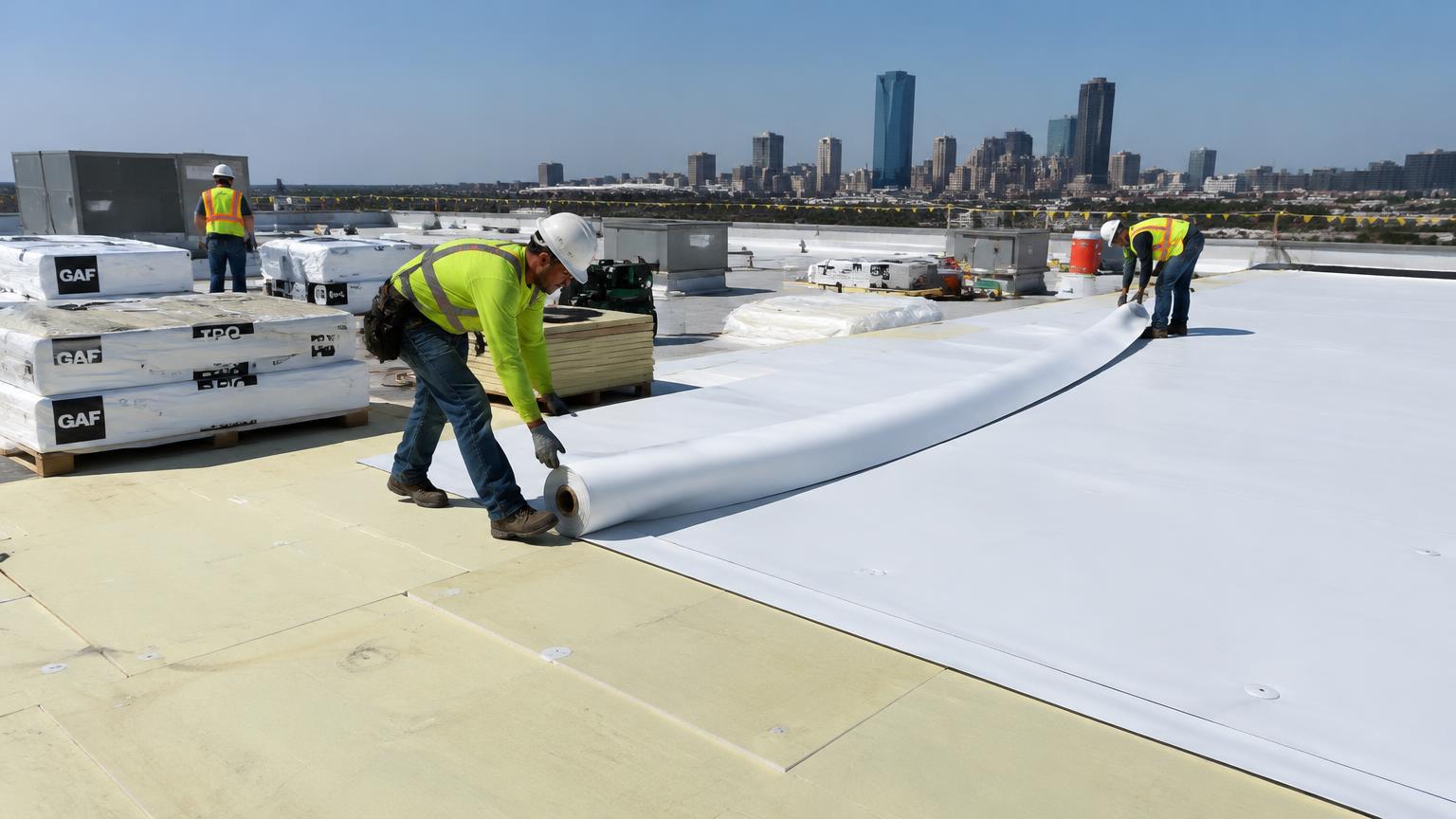
Thermoplastic polyolefin is a white, heat-weldable membrane that reflects a large share of solar radiation and seams with hot-air welding rather than adhesive, producing a more consistent, inspectable seam than adhered lap seams. It's the most commonly installed commercial system in Dallas today because it balances cost, reflectivity, and installation speed better than the alternatives for most building types.
TPO's weak point historically has been long-term seam and membrane stability across formulations — quality varies more by manufacturer than with PVC or EPDM, which is why we only install TPO from manufacturers with a long DFW field track record and a certified-installer NDL warranty program.
PVC: the grease and chemical answer
Polyvinyl chloride membrane is chemically resistant to oils, greases, and many industrial chemicals in a way TPO and EPDM are not. Any restaurant, food-service building, or facility with rooftop chemical exhaust — commercial kitchens along McKinney Avenue and Lower Greenville are a common example — should specify PVC regardless of the cost premium, because grease exposure degrades TPO's plasticizers and can void a TPO warranty outright.
PVC also heat-welds like TPO, giving it similarly reliable seams, and it holds up well in high-UV, high-heat exposure. The tradeoff is cost: PVC typically runs $1.00–$2.00 more per sq ft than a comparable TPO spec.
EPDM: flexibility for older, moving buildings
Ethylene propylene diene monomer (EPDM) is a rubber membrane that handles building movement, settlement, and thermal expansion better than heat-welded single-plies, which can be an advantage on older Dallas buildings with a documented history of structural movement. Its seams are adhered rather than welded, which some contractors consider a slight long-term seam-reliability tradeoff versus heat-welding.
Standard EPDM is black and absorbs heat, adding cooling load in a Dallas summer unless a white EPDM membrane is specified — worth the modest upcharge on nearly any occupied building running rooftop HVAC.
Ponding water: how each system actually performs
None of the three membranes are designed to tolerate long-term ponding, and drainage design matters more than membrane choice here. That said, PVC and TPO's heat-welded seams generally hold up to intermittent ponding better than EPDM's adhered seams over time, while EPDM's material itself is highly resistant to UV degradation in areas that do stay wet.
Regardless of membrane, any Dallas commercial roof with drainage issues should be corrected with tapered insulation crickets during the re-roof rather than relying on membrane choice to compensate for poor slope.
Hail resistance and the DFW hail belt
Dallas–Fort Worth sees Class 4 hail events with meaningful frequency, and thicker membranes across all three systems perform better than thin ones. 80-mil TPO and PVC generally outperform 45-mil or 60-mil EPDM on impact resistance, though ballasted EPDM systems (with a stone or paver ballast layer) get meaningful hail protection from the ballast itself rather than the membrane.
Ask any bidder for the membrane's specific hail-impact test data (typically FM 4470 or UL 2218 testing) rather than assuming all products within a category perform identically — formulation and thickness both matter.
Attachment method: as important as membrane type
Mechanically-attached systems use fastener plates through the insulation into the deck and are the lowest-cost option, but rely on fastener and seam integrity under wind uplift. Fully-adhered systems bond membrane to insulation with adhesive across the full field, generally performing better in high-wind conditions and on taller buildings with higher uplift pressures. Ballasted systems use loose stone or pavers to hold the membrane down and require the deck to support the added weight.
For most Dallas commercial buildings over roughly 30 feet in height or in more exposed locations, we recommend fully-adhered regardless of which of the three membranes is chosen.
Insulation, code, and reflectivity — same rules across all three
Whichever membrane you choose, the same code and performance rules apply underneath it. Texas's adopted energy code requires R-25 to R-30 continuous insulation for most commercial roofs, and tapered ISO for positive drainage is worth the added cost on any system. White membranes (TPO, PVC, or white EPDM) all deliver a meaningful cooling-load reduction over dark membranes on a building with rooftop HVAC exposure to full Dallas sun.
Straight recommendations by building type
For a standard office, retail, or warehouse building with no unusual chemical exposure, TPO is the right default in nearly every case — best balance of cost, reflectivity, and warranty availability. For any building with rooftop grease or chemical exhaust, specify PVC regardless of the premium; using TPO in that environment risks a voided warranty within a few years.
For an older building with documented settlement or movement, or where the roof deck has some flexibility built into its original design, EPDM's rubber flexibility is worth the tradeoff versus TPO or PVC's more rigid heat-welded seams. When in doubt, a structural and moisture survey before the RFP goes out will settle the question faster than a spec-sheet comparison alone.