Every commercial roof replacement conversation in Dallas-Fort Worth starts the same way: the owner wants a number, and the honest answer is a range that depends on more variables than most bids disclose. We've priced flat and low-slope commercial roofs across DFW long enough to know that the membrane type sets the baseline, but building geometry, deck condition, and code compliance are what actually determine the final invoice.
This guide breaks down 2026 installed cost ranges by system, then walks through the line items that push a project from the low end of a range to the high end. If you manage a single building or a multi-site portfolio, use this to sanity-check bids before you sign anything.
Cost per square foot by system
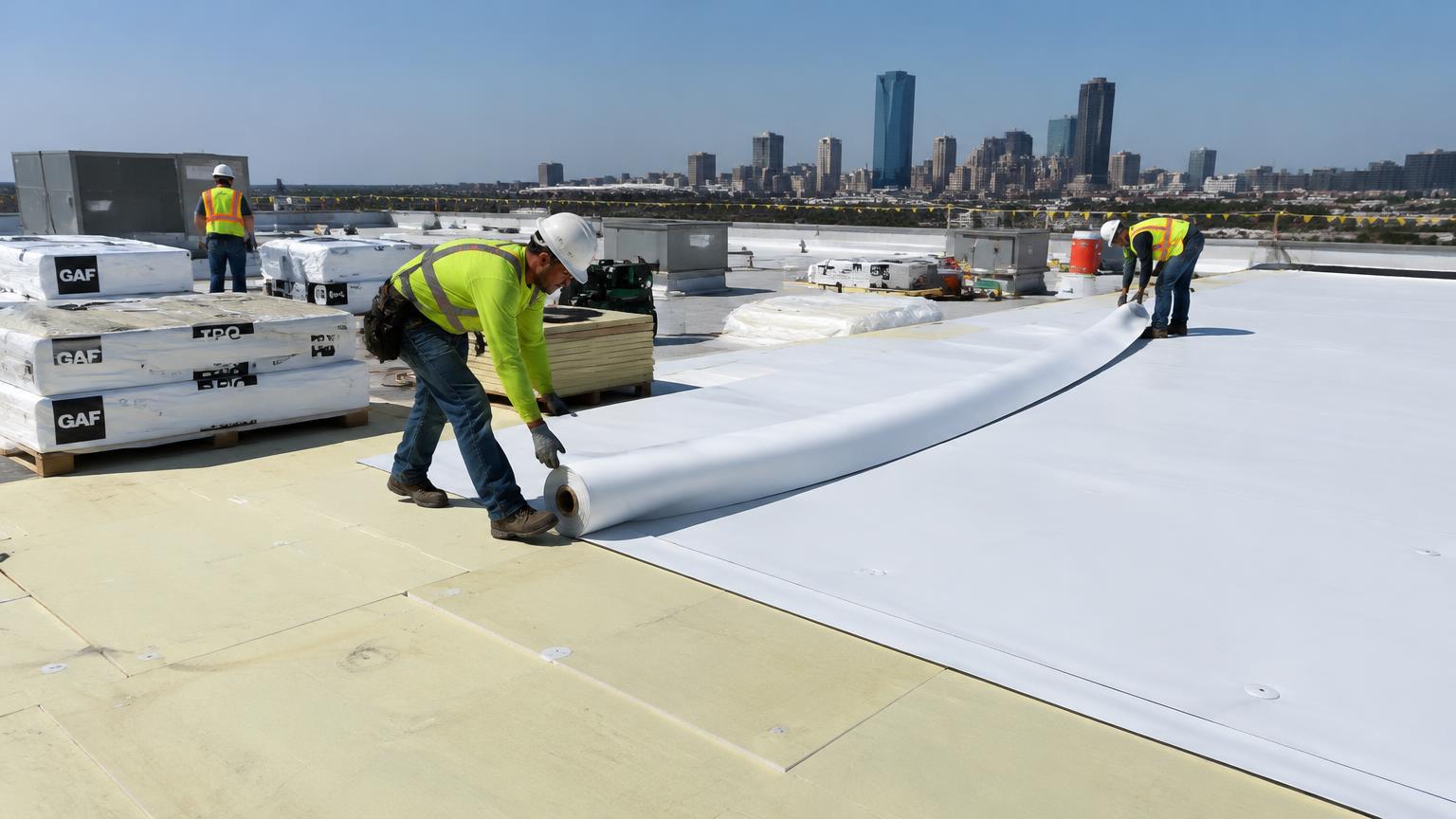
Single-ply membranes dominate new commercial roofing in North Texas because they balance material cost, install speed, and reflectivity. TPO (thermoplastic polyolefin) installed cost in DFW has been running $6.50 to $9.50 per sq ft for a mechanically-attached system with polyiso insulation, and $8.00 to $11.50 for fully-adhered systems on higher-wind-exposure buildings. PVC, chemically similar in install method but pricier in raw material and typically specified where grease exposure or chemical resistance matters (restaurants, industrial buildings), runs $7.50 to $11.50 per sq ft.
Modified bitumen (torch-applied or self-adhered SBS/APP) sits at $6.00 to $9.00 per sq ft installed and remains a solid choice on buildings with heavy foot traffic or rooftop equipment where puncture resistance matters more than reflectivity. EPDM, the least expensive single-ply option, runs $5.00 to $8.00 per sq ft — still common on warehouses and industrial buildings where black roof aesthetics and lower up-front cost outweigh the energy-code reflectivity argument.
Standing-seam metal retrofit over a low-slope structure runs considerably higher, typically $11 to $18 per sq ft once you account for structural bracing, purlins, and hand-formed flashing detail. Built-up roofing (BUR), still specified on some older DFW industrial and institutional buildings, lands at $7.00 to $10.50 per sq ft and remains one of the most durable options for gravel-ballasted roofs that see minimal rooftop traffic.
- TPO mechanically-attached: $6.50–$9.50/sq ft | fully-adhered: $8.00–$11.50/sq ft
- PVC: $7.50–$11.50/sq ft
- Modified bitumen (SBS/APP): $6.00–$9.00/sq ft
- EPDM: $5.00–$8.00/sq ft
- Standing-seam metal retrofit: $11.00–$18.00/sq ft
- Built-up roofing (BUR): $7.00–$10.50/sq ft
How building size changes the unit cost
Mobilization, crane rental, dumpster staging, and crew setup are largely fixed costs regardless of roof size, which means a 5,000 sq ft strip-center roof will always carry a higher per-square-foot price than a 100,000 sq ft distribution center next door using the identical membrane. On a small roof under 10,000 sq ft, expect to land at the top of the ranges above, sometimes higher, because fixed costs are spread across so little area.
The economy of scale curve flattens meaningfully above roughly 50,000 sq ft. A 200,000 sq ft roof isn't dramatically cheaper per square foot than a 60,000 sq ft roof of the same system — at that point, material cost dominates and labor efficiency gains have already been captured. If you're comparing a bid on a large facility against a national benchmark price you saw online, remember that number was likely generated from a much larger reference building.
Tear-off versus recover
A recover — installing a new membrane over the existing roof system rather than removing it — can cost 20% to 35% less than full tear-off because it eliminates disposal fees and labor for demolition. The International Building Code generally allows one recover layer over an existing single-ply or BUR system, provided the existing roof is dry, structurally sound, and not already carrying two layers.
In practice, recover is the exception rather than the rule on DFW commercial replacements. Most roofs we evaluate for replacement have wet insulation somewhere, deck deflection, or an existing system that's already at its layer limit — any of which forces tear-off regardless of what the owner would prefer to spend. A qualified roof moisture survey before bidding tells you which path is realistic; skipping that step is how owners end up mid-project with a change order for a recover that should have been a tear-off from day one.
Insulation and Texas energy code requirements
The 2021 International Energy Conservation Code, as adopted with amendments across most DFW municipalities, requires a minimum R-value for low-slope commercial roof insulation — generally R-20 to R-25 continuous insulation depending on climate zone designation and roof assembly type. If your existing roof was installed under an older code cycle, a straight recover may not meet current requirements, which is one more reason recover projects often get reclassified to tear-off with new insulation.
Polyisocyanurate (polyiso) is the standard insulation choice in DFW commercial reroofing because it delivers the highest R-value per inch of any common roof insulation, keeping the finished roof assembly thickness manageable at rooftop unit curbs and parapet transitions. Tapered polyiso systems, which correct drainage slope while meeting R-value requirements, add cost but frequently pay for themselves by eliminating standing water — a major cause of premature membrane failure.
Deck type and structural considerations
Steel deck, the most common substrate on DFW commercial and light-industrial buildings, is generally the least expensive to work with — it accepts mechanical fasteners cleanly and rarely needs repair unless there's been long-term moisture infiltration causing rust-through. Lightweight insulating concrete deck, common on some older schools and municipal buildings, requires different fastening patterns and sometimes a base sheet, adding cost.
Wood plank or plywood decking, found on some older retail strip centers, needs careful inspection for rot and delamination; any section requiring replacement typically adds $3 to $6 per sq ft for that isolated area. Concrete deck, common on parking structures and some mid-rise buildings, is durable but adds cost when penetrations require core drilling for new drains or curbs.
Drainage, penetrations, and curb work
Roof drains, scuppers, and internal gutters are frequently the actual root cause of the leak that triggered the replacement conversation in the first place — and they're commonly underestimated in initial walk-throughs. Adding or relocating a drain, correcting negative slope with tapered insulation, or replacing a scupper assembly can each add several thousand dollars to a project that otherwise looked straightforward on paper.
Every rooftop penetration — HVAC curbs, plumbing vents, conduit runs, satellite dish mounts, skylights — needs new flashing at replacement, and older buildings tend to accumulate a surprising number of these over decades of tenant modifications. A 30,000 sq ft big-box roof with 40+ penetrations takes meaningfully more labor than an identical roof with 10 penetrations, even though the membrane material cost is the same. Get an accurate penetration count during the estimate walk, not after tear-off begins.
Access, logistics, and permitting
Crane cost for hoisting insulation boards and membrane rolls to the roof varies with building height and site access — a downtown Dallas high-rise with limited street access and a strict loading-dock schedule costs more to mobilize than a suburban single-story building with an open parking lot. Multi-day crane rental, material staging fees, and after-hours work required by a tenant's operating hours all show up as separate line items and should be itemized in your bid, not buried in a lump sum.
Most DFW municipalities require a building permit for commercial roof replacement, plus inspections at insulation attachment and final membrane stages. Permit fees are typically a few hundred to a couple thousand dollars depending on project value and jurisdiction, and a legitimate contractor pulls the permit in their name rather than asking the owner to self-permit.
Warranty cost tiers and capital planning
Manufacturer warranties on single-ply systems typically range from 15 to 30 years, with the longer terms requiring a manufacturer-certified installer, specific fastening patterns, and sometimes a manufacturer inspection at closeout. Extending from a 20-year to a 30-year NDL (no dollar limit) warranty commonly adds a modest premium to material cost but is usually worth it on a building the owner plans to hold long-term, since the warranty transfers with ownership in most cases.
For capital planning purposes, budget commercial roof replacement on a straight-line basis against expected service life: 20–25 years for most single-ply systems, 30+ years for a well-maintained standing-seam metal retrofit. Building that depreciation schedule into a reserve fund avoids the scramble that happens when a roof fails without warning. Our commercial replacement and preventative maintenance teams frequently work together on this exact planning exercise for property managers overseeing multiple buildings.
Reading a real estimate and spotting red flags in low bids
A trustworthy commercial roofing estimate breaks out material cost by component (membrane, insulation, fasteners, flashing), labor, tear-off and disposal, any deck repair allowance, permit fees, and warranty registration cost — not a single lump number. If a bid is dramatically lower than competing bids, check what's missing: insufficient insulation thickness, a shorter warranty term, no line item for deck repair contingency, or membrane thickness below manufacturer minimum for the warranty being quoted.
It's also worth asking every bidder the same specific questions: what membrane thickness (60 mil vs 80 mil TPO makes a real difference), what fastening pattern for your wind zone, whether tapered insulation is included to correct existing ponding, and whether the crew doing the work is the manufacturer-certified crew or a subcontracted labor pool. Our team walks Dallas-Fort Worth property managers through exactly this comparison as part of every commercial flat roof proposal, and we encourage owners to get that same breakdown from any contractor bidding the job — you'll usually find that the lowest number on the page has quietly cut one of these corners.