Dallas industrial property has quietly become one of the most active commercial roofing markets in the country. The tenant expectations that came with the last cycle — 24/7 operations, temperature-sensitive inventory, e-commerce fulfillment SLAs — have made downtime the single largest hidden cost of a bad re-roof.
This is a playbook, not a sales pitch: the membrane spec, the insulation package, the phasing sequence, and the warranty paperwork that separate a re-roof that lasts 25 years from one that leaks by year eight. If you manage a distribution center, cold-storage box, or light-manufacturing building anywhere from Love Field to the Great Southwest industrial corridor, the numbers below are what you should be comparing bids against.
2026 cost per square foot, by system and building size
Commercial roofing is priced per square (100 sq ft) or per square foot, and the number moves with building size, deck condition, and insulation thickness far more than with membrane brand. On a straightforward flat industrial roof, expect these installed ranges for a full tear-off and replacement in the Dallas–Fort Worth market this year.
Smaller buildings carry a cost premium because mobilization, crane time, and dumpster logistics are largely fixed costs spread over fewer squares. A 25,000 sq ft building will price noticeably higher per foot than a 250,000 sq ft distribution center using the identical spec.
- 60-mil mechanically-attached TPO: $8.25–$11.75 per sq ft
- 80-mil fully-adhered TPO with tapered ISO: $9.50–$14.50 per sq ft
- 60-mil PVC (grease/chemical exposure): $10.50–$15.75 per sq ft
- EPDM ballasted or fully-adhered: $7.75–$12.50 per sq ft
- Silicone or acrylic restoration coating (eligible roofs only): $3.75–$6.25 per sq ft
Why 80-mil, not 60-mil
60-mil TPO is the manufacturer's minimum thickness and dominates residential and light commercial work. On a 100,000+ sq ft distribution facility with foot traffic, mechanical service access, and hail exposure, the added cost to go 80-mil is roughly $0.35–$0.55 per sq ft — well under 5% of the total project — and it adds 5–10 years of realistic service life plus meaningfully better puncture and hail resistance.
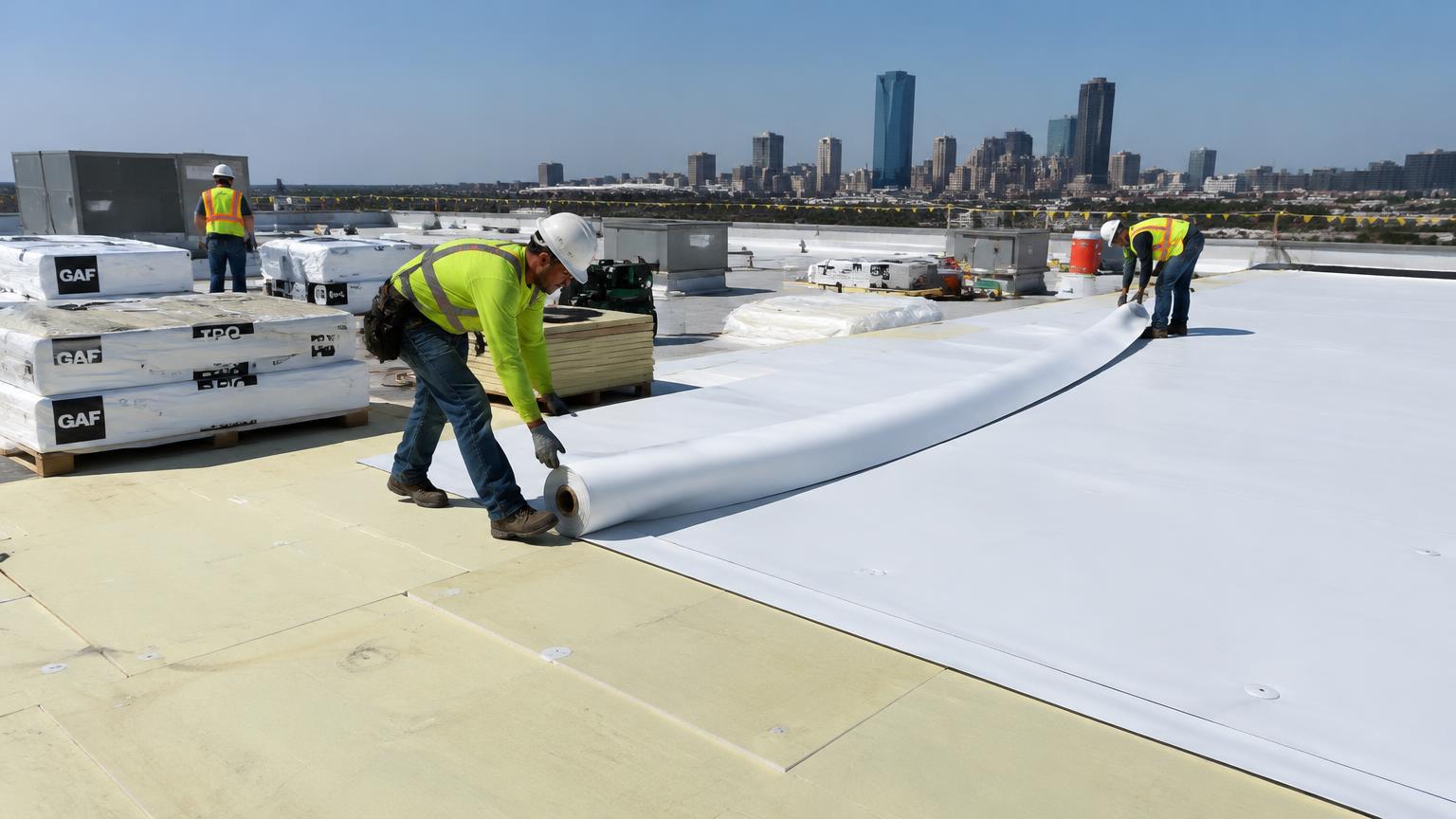
Attachment method matters as much as thickness. Mechanically-attached TPO is less expensive up front but relies on fastener plates and seams under uplift load; fully-adhered systems bond the membrane directly to the insulation with a low-VOC adhesive, which performs better in Dallas's high-wind, high-UV cycle and is what we specify on any building over roughly 50,000 sq ft.
Insulation, R-value, and the Texas energy code
The 2021 International Energy Conservation Code, as adopted by the City of Dallas and most surrounding jurisdictions, sets minimum roof insulation at R-25 to R-30 continuous for most commercial occupancy types — up from R-20 in older code cycles. A re-roof that only replaces the membrane and reuses old 1990s-era flat insulation will fail a permit inspection on many projects and leaves real energy cost on the table regardless.
We build most Dallas industrial re-roofs with 2–3 layers of polyisocyanurate (ISO) board, staggered and mechanically fastened or adhered, to hit code R-value while also correcting slope. Going one insulation thickness above code minimum typically adds $0.60–$1.10 per sq ft and pays back through lower cooling load within 4–7 years on a building running rooftop HVAC through a Dallas summer.
Tapered ISO and drainage: don't skip it
Most 1990s and early-2000s Dallas industrial roofs were built with 4" or 6" flat insulation and pray-for-slope drainage. TPO's reflectivity and seam integrity depend on the membrane staying dry — ponding water that sits more than 48 hours after a storm is the number one cause of premature TPO and PVC failure we see in North Texas.
For a re-roof, we build a 1/4" per foot tapered ISO system engineered to primary and secondary drains and scuppers, with crickets behind curbs and rooftop units. It typically adds $1.75–$2.75 per sq ft over flat insulation and roughly doubles the practical service life of the membrane by eliminating standing water.
- Positive drainage: no ponding beyond 48 hours after rainfall per NRCA guidance
- Crickets required behind any curb, HVAC unit, or wall wider than 24 inches
- Secondary (overflow) drains or scuppers are required by code — verify they aren't painted shut or blocked by old roofing debris
Cool-roof reflectivity and the Dallas heat load
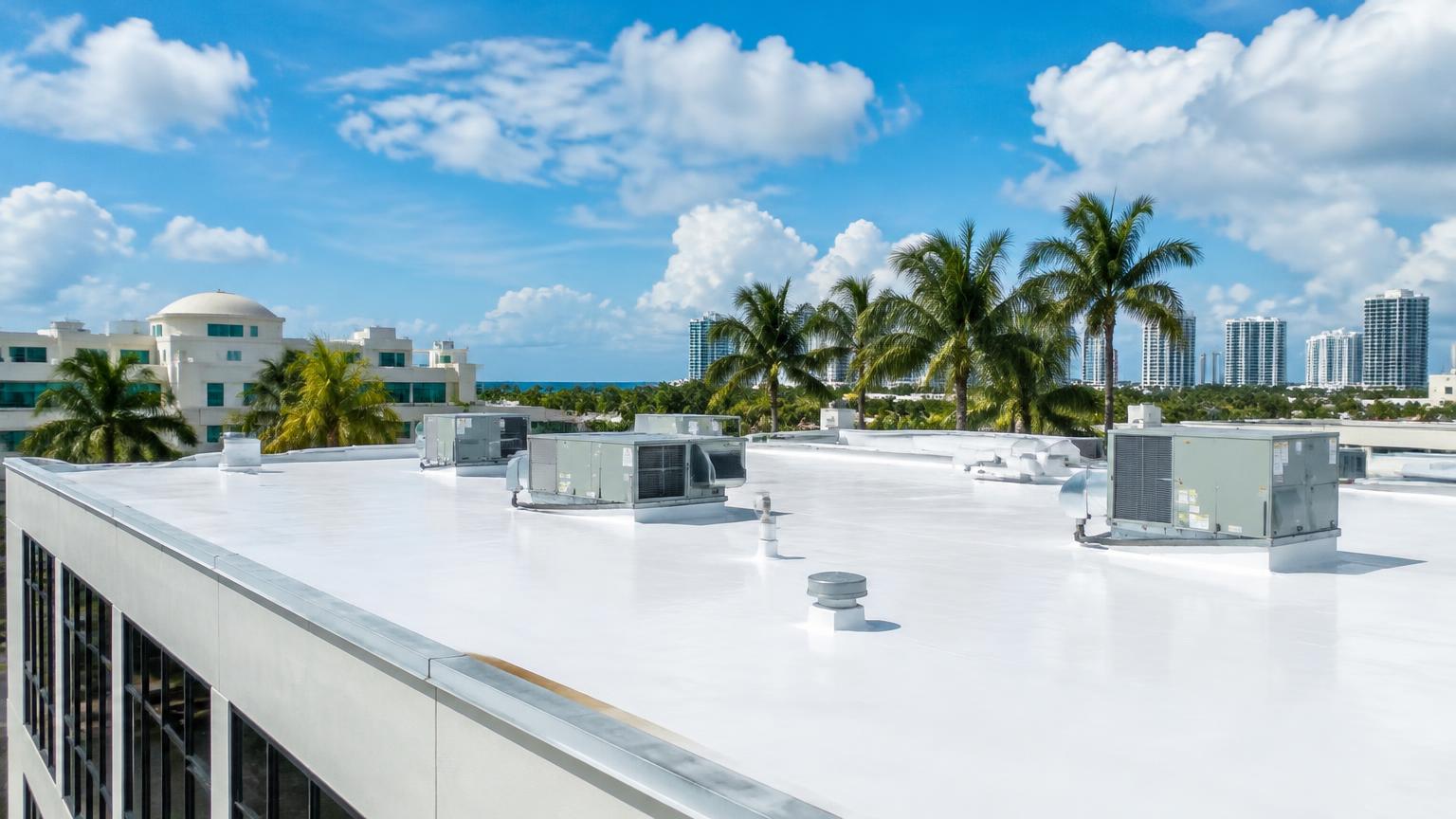
White TPO and PVC membranes reflect 80%+ of solar radiation when new, compared to under 20% for aged built-up roofing or dark EPDM. On a Dallas industrial building running rooftop package units through a summer where the roof surface can exceed 160°F, that reflectivity difference shows up directly on the utility bill and on compressor run-time.
ENERGY STAR-rated membranes also qualify many Dallas facilities for utility rebate programs through Oncor's commercial efficiency incentives. Ask your roofer for the membrane's initial and 3-year-aged solar reflectance index (SRI) values — reflectivity does degrade with dirt accumulation and needs to be part of your maintenance program, not just a spec-sheet number.
Tear-off vs. recover: how to know which you qualify for
A recover — installing new insulation and membrane over the existing roof assembly — is 25–40% cheaper than tear-off but is only defensible when the existing insulation is verifiably dry. We require an infrared moisture survey plus core cuts before recommending recover on any building over 20,000 sq ft.
Most manufacturers also cap recover systems at two existing roof layers by code, and many Dallas-area buildings that have already been recovered once are no longer eligible. If moisture shows up anywhere in the survey, tear-off is the only defensible answer — a recover over wet insulation traps moisture and can void the new warranty within the first year.
Phasing for zero downtime
A 200,000 sq ft distribution facility does not close for a roof. We phase the work in 15,000–25,000 sq ft daily sections, tarp the deck to a dry-in condition every evening regardless of forecast, and coordinate around loading dock schedules, HVAC service windows, and roof-mounted equipment. In the last two years we have completed more than a million square feet of Dallas industrial re-roofing without a single day of tenant downtime.
The same discipline applies to smaller buildings. Even a 40,000 sq ft light-manufacturing roof benefits from a written daily phasing plan reviewed with the facility manager before tear-off starts — it is the cheapest insurance against a surprise rain event soaking inventory.
Permits, inspections, and warranty paperwork
Dallas and most surrounding municipalities (Irving, Grand Prairie, Garland) require a building permit for commercial re-roofing, with inspections tied to insulation R-value, fastener pattern, and drainage. Tarrant County cities including Fort Worth and Arlington run a similar process through their own building departments — never assume a permit pulled in one city transfers to another.
A GAF Diamond Pledge, Carlisle Golden Seal, or Johns Manville Peak Advantage NDL (No Dollar Limit) warranty covers both materials and labor for up to 20–25 years — but only if issued by a certified installer and only if the roof passes the manufacturer's own closeout inspection. Ask for the warranty certificate number the day the job is signed off; a workmanship-only warranty from the contractor is not a substitute for a manufacturer NDL warranty.
- Material-only warranty: covers membrane defects, not labor to fix a leak — the weakest tier
- Workmanship warranty: covers installer error, typically 2–10 years, only as good as the company issuing it
- NDL warranty: covers materials and labor, no dollar cap, requires certified-installer status at time of install
Evaluating bids: what to put in your RFP
Every RFP for a Dallas industrial re-roof should require bidders to state membrane thickness and attachment method, insulation R-value and layer count, drainage design (with a written statement on cricket placement), tear-off vs. recover justification backed by a moisture survey, warranty type and term, and a written phasing plan for occupied operations. Bids that omit any of these are not comparable to each other regardless of the bottom-line number.
A preventative maintenance program should be part of the conversation before the ink dries, not an afterthought a year later — most manufacturer NDL warranties require documented biannual inspections to stay valid, and a maintenance contract is typically the cheapest insurance you can buy against a mid-life membrane failure.